 GenGrowth
AI Marketing Automation for SaaS: From Content to Conversion
SaaS marketing teams face a persistent challenge: bridging the gap between producing content and driving conversions.
Key Takeaways
- AI marketing automation for SaaS covers the full pipeline from content creation to conversion tracking, but tools differ sharply in execution style and price.
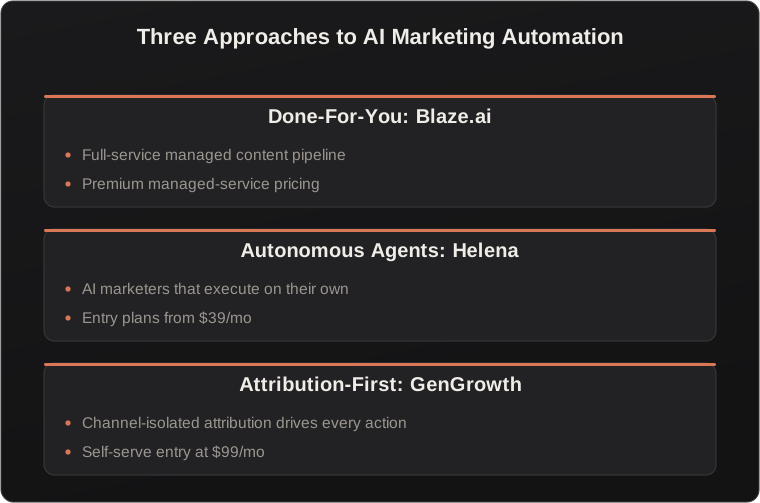
- Three distinct approaches exist: fully managed services (Blaze.ai), autonomous agent-based execution (Helena), and attribution-driven automation (GenGrowth).
- For early-stage SaaS, lower-cost tools with built-in validation (GenGrowth at $99/mo or Helena at $39/mo) offer a safer entry point than premium managed services.
- Attribution accuracy — especially channel isolation — is a key differentiator that directly affects ROI evaluation and optimization decisions.
- No single tool fits all stages; the right choice depends on team capacity, budget, and whether you need strategy suggestions or hands-off execution.
1. Introduction
SaaS marketing teams face a persistent challenge: bridging the gap between producing content and driving conversions. Traditional workflows involve separate teams for SEO, paid ads, social media, email, and landing pages — and the data silos between them make attribution nearly impossible. AI marketing automation promises to unify this pipeline, but with dozens of tools claiming to "automate everything," it's hard to separate genuine capabilities from marketing hype.
This article examines three concrete approaches to AI marketing automation for SaaS — represented by Blaze.ai, Helena (by Enrich Labs), and GenGrowth — using verified facts about their features, pricing, and execution models. We'll focus on what each approach actually delivers from content to conversion, and help you decide which model fits your SaaS stage, budget, and growth goals.
2. The "Done-For-You" Model: Blaze.ai's Full-Service Pipeline
Core conclusion: Blaze.ai targets SaaS companies that want complete outsourcing of marketing execution across multiple channels, but at a premium price that typically suits established businesses with higher budgets.
Blaze.ai positions itself as a comprehensive marketing automation platform built on five pillars: Organic Content (covering eight channels including social media, blog, email newsletters, and Google My Business), Paid Ads (Google and Meta), Landing Pages, Reputation Management, and AI SDR (answering calls, qualifying leads, and booking appointments). The "Done-For-You" managed service is priced per module at $1,049/mo per pillar, with a recommended 12-month commitment. This pricing suggests the target customer is not a bootstrapped startup but a revenue-generating SaaS with at least 2–3 pillars active.
A unique architectural feature is Blaze.ai's "Learning Loop" — a cross-pillar coordination mechanism where high-performing social posts feed back into ad creative, positive reviews improve landing pages, and AI SDR data informs content strategy. This cross-pollination directly addresses the "content-to-conversion" gap by ensuring that every channel learns from the others. For example, a blog post that drives high engagement can automatically influence the ad copy for the same product.
Blaze.ai's scale is documented: 130,000+ customers worldwide, 87 million impressions generated, and a lean team of 31 employees. That customer count suggests strong adoption, but note that "customers" may include free or trial users.
Scenario advice: Use Blaze.ai if your SaaS has a dedicated marketing budget and you want a single vendor to manage the full funnel — content, ads, landing pages, and even inbound calls. Be prepared for a longer commitment (3–12 months) to see the learning loop mature.
3. The Autonomous Agent Model: Helena's "AI Marketers That Execute"
Core conclusion: Helena represents a newer, agent-based approach where the AI doesn't just recommend — it writes, publishes, optimizes, and reports across all channels autonomously, at a fraction of the cost of managed services.
Helena is marketed as "the first autonomous AI marketer" that handles SEO, ads, social, and email, and reports performance to your inbox every morning. Its core differentiator is that it executes rather than merely recommends — a meaningful shift from tools that only provide suggestions. Enrich Labs, the company behind Helena, positions it as "the first agentic marketing platform" with 50+ core AI marketing workflows built from human expertise.
The product line consists of named specialist agents: Helena (AI Digital Marketer), Sam (AI SEO/GEO Manager), Kai (AI Social Listening Manager), Angela (AI Email Marketer). Each agent focuses on a specific domain, yet they presumably share data to create a cohesive strategy.
Pricing is deliberately accessible: entry at "$39/mo" with a 3-day free trial and cancel-anytime. This price point opens the door for early-stage SaaS teams. However, the 3-day trial is very short for evaluating multi-channel execution; you'll need to run a small campaign quickly to assess output quality.
Scenario advice: Helena fits SaaS teams that have a clear content strategy but lack the bandwidth to execute across all channels. Because the agents execute autonomously, you need to be comfortable with the AI making publishing decisions on your behalf. Start with one agent (e.g., Helena for overall digital marketing) and expand after validating results.
4. The Attribution-First Model: GenGrowth's Channel-Isolated Execution
Core conclusion: GenGrowth prioritizes what most automation tools neglect — accurate attribution — by offering UTM fingerprinting and channel isolation that "no competitor provides," according to its website, combined with automated execution and self-optimization.
GenGrowth's approach is built on attribution as the foundation for optimization. It claims that its UTM fingerprinting and channel isolation are unique in the market. This matters because without accurate attribution, you cannot determine which content led to a conversion — a core problem in the "content to conversion" pipeline. GenGrowth also offers a self-optimization loop that automatically adjusts execution based on performance data.
The product is tiered: Starter at $99/mo (Discovery + Strategy: auto opportunity discovery, strategy generation with scoring, priority ranking, weekly reports, 1 product); Pro at $199/mo (Full Growth Loop: adds automated execution across SEO/Social/Link, channel-isolated attribution, 6-dimension data integrity, self-optimization, social-first validation, 3 products); Growth at $299/mo (Scale + Knowledge: unlimited products, playbook cross-product reuse, competitor monitoring with weekly diff, priority support, custom execution templates). All plans include a 14-day free trial with full features and no credit card required.
GenGrowth explicitly compares itself to tools like Okara and BabyLoveGrowth that only give suggestions at the $99/mo price point, while its Pro and Growth tiers deliver automated execution plus channel-isolated attribution and self-optimization.
Scenario advice: Choose GenGrowth if attribution accuracy is your top priority, or if you've previously used suggestion-only tools and found them lacking. The 14-day free trial is generous enough to test attribution on a real campaign. Start with the Pro tier ($199/mo) for the full execution + attribution loop; the Starter tier is more suited for strategy research before committing to automation.
5. Key Comparison: Choosing Your AI Marketing Automation Approach
| Feature / Criterion | Blaze.ai | Helena (Enrich Labs) | GenGrowth |
|---|---|---|---|
| Execution model | Fully managed (Done-For-You) | Autonomous AI agents (execute) | Automated execution + self-optimization |
| Entry price | $1,049/mo per module | $39/mo | $99/mo (Starter) / $199/mo (Pro) |
| Channel coverage | 5 pillars: Organic, Paid, Landing Pages, Reputation, AI SDR | SEO, Ads, Social, Email (multiple agents) | SEO, Social, Link building (Pro) |
| Attribution | Cross-pillar Learning Loop | Not specified in verified evidence | UTM fingerprinting + channel isolation (unique claim) |
| Trial | Not specified in verified evidence | 3-day free trial, cancel anytime | 14-day free trial, full features, no credit card |
| Best for | SaaS with a substantial budget, wants hands-off outsourcing | Early-stage SaaS wanting affordable autonomous execution | SaaS teams that prioritize attribution and optimization |
| Scalability constraints | 12-month commitment recommended; modules priced individually | 50+ workflows (claimed); short trial period | 3 products on Pro, unlimited on Growth |
Practical considerations:
- Data integrity: GenGrowth mentions "6-dimension data integrity" and channel isolation — if accurate attribution is critical for your SaaS's reporting to investors or leadership, this matters.
- Human oversight needed: Blaze.ai's managed service requires less daily involvement but higher cost. Helena's autonomous agents require you to trust AI publishing decisions. GenGrowth's automated execution still benefits from periodic human review of the weekly reports.
- Trial length: GenGrowth's 14-day trial is much more suitable for a thorough evaluation than Helena's 3-day trial. Plan your trial accordingly.
6. FAQ
Q1. Which AI marketing automation tool is best for a two-person SaaS startup?
For a lean team, the most cost-effective entry is Helena at $39/mo or GenGrowth Starter at $99/mo. Helena gives you autonomous execution across multiple channels with minimal setup, while GenGrowth provides discovery and strategy generation plus a 14-day risk-free trial. Avoid Blaze.ai unless you have dedicated marketing budget — the $1,049/mo per module is too steep for most early-stage startups.
Q2. Why is attribution so important in the content-to-conversion pipeline?
Without accurate attribution, you cannot determine which content piece, ad, or channel actually drove a conversion. This leads to misallocated budgets (e.g., doubling down on low-performing content) and poor optimization. Tools like GenGrowth that offer channel-isolated attribution enable you to trace each conversion to its source, then feed that data back into content and ad optimization — closing the loop from content to conversion.
Q3. I already use a suggestion-only tool (e.g., Okara). Should I upgrade to an execution tool?
If your current tool provides suggestions but you lack the time or expertise to act on them, upgrading to an execution tool like GenGrowth (Pro tier) or Helena makes sense. GenGrowth explicitly positions its Pro/Growth tiers as superior to suggestion-only competitors at the same price point. However, if your team is already executing well on suggestions, the additional automation may not justify the cost. Consider a trial first.
Q4. Can I use more than one of these tools simultaneously?
Technically yes, but it may create data conflicts and double attribution issues. For example, running organic content on Blaze.ai while using GenGrowth for attribution could lead to UTM mismatches. It's better to pick one primary platform that covers your core channels and attribution. For a single-vendor approach, Blaze.ai covers the widest range (including reputation management and AI SDR), but at the highest cost.
7. Conclusion
AI marketing automation for SaaS is not a one-size-fits-all category. The tools we analyzed demonstrate three distinct philosophies: Blaze.ai's fully managed, high-cost learning loop; Helena's low-cost, autonomous agent execution; and GenGrowth's attribution-first automated execution.
Final recommendations:
- If you have a substantial marketing budget and want full outsourcing, evaluate Blaze.ai on a 3-month pilot for one module first.
- If you are an early-stage SaaS with a small team and need execution without high cost, start with Helena's $39/mo plan for a quick 3-day trial — but be ready to validate quality thoroughly.
- If attribution quality is your primary concern and you have a modest monthly budget to invest, GenGrowth's Pro tier offers the unique combination of automated execution and channel-isolated attribution with a 14-day free trial.
Whichever path you choose, prioritize tools that close the loop from content to conversion with real data — not just suggestions. The ability to trace every lead back to a specific content piece and automatically optimize based on that data is what separates true automation from expensive to-do lists. Start with a trial, measure attribution from day one, and scale only after you see validated results.
Sources
GenGrowth Team
Growth Automation Engineers
We build tools that help product teams automate growth experiments.
Related Articles
- methodologyGenGrowth vs Blaze: AI Growth Automation vs AI Content CreationMarketing teams and founders today face a noisy landscape of AI tools promising to replace manual work. Two distinct approaches have emerged: AI content creation and AI growth automation.
- methodologyGenGrowth vs Okara: Two Approaches to the AI CMOThe AI marketing space is experiencing a paradigm shift. Founders and growth teams are questioning whether they need large in-house marketing teams or can rely on AI-driven tools to do the heavy lifting — especially in…
- methodologyThe Best AI Marketing and CMO Tools for SaaS in 2026SaaS marketing teams in 2026 face a fragmented landscape: disconnected analytics, manual campaign management, and growing pressure to do more with fewer resources.