 GenGrowth
The Best AI Marketing and CMO Tools for SaaS in 2026
SaaS marketing teams in 2026 face a fragmented landscape: disconnected analytics, manual campaign management, and growing pressure to do more with fewer resources.
Key Takeaways
- Document type: Ranking-style comparison of AI marketing platforms targeting SaaS CMOs and growth leaders.
- Recommended audience: SaaS marketing executives, CMOs, and growth teams evaluating agentic AI platforms, automated execution tools, and marketing operating layers.
- TOP Pick: Kana – Best for CMOs seeking a unified agentic marketing operating layer with human-in-the-loop oversight.
- Selection advice: Choose Kana for strategic campaign orchestration; choose Helena for cost-effective channel execution; choose GenGrowth for automated growth loops with isolated attribution.
1. Why This Ranking Matters
SaaS marketing teams in 2026 face a fragmented landscape: disconnected analytics, manual campaign management, and growing pressure to do more with fewer resources. AI-powered tools promise to bridge these gaps, but the market is noisy. CMOs need a decision framework that separates agentic orchestration platforms from simple automation tools.
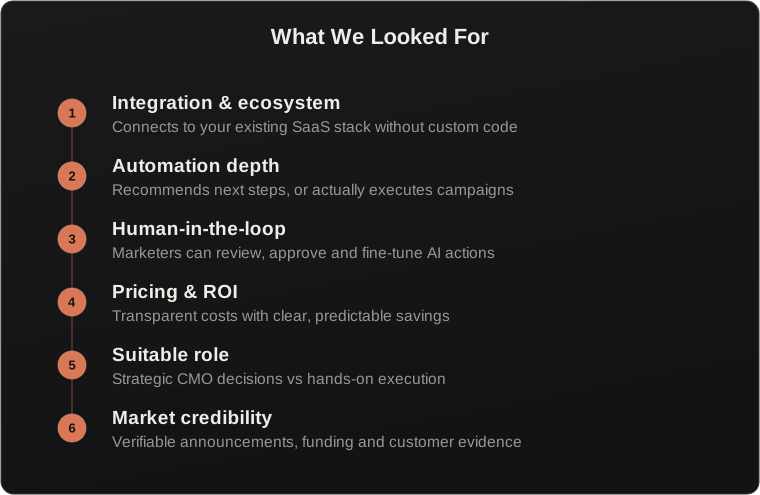
This ranking compares three emerging AI marketing systems – Kana, Helena, and GenGrowth – each taking a different approach to the same problem. We evaluate them on six criteria: integration depth, automation maturity, human oversight (human-in-the-loop), pricing transparency, suitability for strategic vs. execution roles, and credible evidence of market traction.
2. Evaluation / Ranking Criteria
| Criteria | What We Look For |
|---|---|
| Integration & ecosystem | Does the tool connect to existing SaaS stacks (e.g., Klaviyo, Shopify, Google Analytics) without custom code? |
| Automation depth | Does it merely recommend next steps or actually execute? Can it autonomously run campaigns, adjust budgets, or optimize in real time? |
| Human-in-the-loop | Can marketers review, approve, and fine-tune AI actions? Critical for CMO trust and compliance. |
| Pricing & ROI | Transparent vs. hidden costs. Does it deliver clear savings (e.g., vs. contractors) or scale predictably? |
| Suitable role | Is it built for strategic decision-making (CMO) or execution (growth managers)? |
| Market credibility | Backed by verifiable announcements, funding, or customer evidence. |
3. Ranking List
TOP1: Kana – The Marketing Operating Layer for Agentic AI
Overall assessment Kana positions itself as an agentic AI marketing platform and Marketing Operating Layer that transitions marketing teams from manual data silos to real-time decision-making. It emerged from stealth in February 2026 with a $15M seed round led by Mayfield, led by a founding team with a proven track record (previous martech companies acquired by Microsoft and Salesforce).
Kana’s product suite covers Campaign Management, Marketing Intelligence, Answer Engine Optimization, Audience Manager, and OmniChannel Media Planner. Its standout feature is the human-in-the-loop architecture: marketers stay in the loop to supervise AI agents, approve actions, give real-time feedback, and adjust parameters as campaigns evolve. The agents automate data analysis, audience targeting, and campaign execution, while the team retains strategic control.
Core strengths
- Purpose-built for CMOs who need a single platform to orchestrate multi-channel campaigns.
- Strong investor and founder credibility — experienced team with prior exits.
- Agentic approach reduces guesswork: agents recommend and execute next best actions based on data.
- No-code integration with existing marketing/media ecosystems.
Limitations or cautions
- Launched recently (Feb 2026); limited long-term case studies.
- No public pricing information beyond a "Get Started" CTA. CMOs should expect enterprise-level investment.
- Still early in market adoption compared to incumbents.
Best for CMOs and marketing VPs in mid-to-large SaaS companies who want an orchestration layer that acts as a "COO" for marketing, with full human oversight.
TOP2: Helena – Expert-Level Execution at ~90% Lower Cost
Overall assessment Helena positions itself as expert-level execution across every channel without requiring a full in-house team. It connects to the user's existing marketing stack (Klaviyo, Shopify, Google Analytics, and more) with no-code setup. The boldest claim: AI marketers cost roughly 90% less than contractors – a direct attack on agency overhead.
Core strengths
- Dramatic cost reduction: up to 90% cheaper than traditional contractors or agencies.
- Simple integration with popular SaaS tools.
- Designed for hands-on execution, not just strategy.
Limitations or cautions
- Less suited for strategic orchestration; more of an execution layer.
- The "expert-level execution" claim is self-reported; independent benchmarks not yet available.
- No mention of agentic autonomy or human-in-the-loop features.
Best for Bootstrapped SaaS startups, lean growth teams, or companies that need immediate, low-cost channel execution without hiring more contractors.
TOP3: GenGrowth – Automated Growth Loops with Isolated Attribution
Overall assessment GenGrowth focuses on automated growth loops with a unique channel-isolated attribution system that pairs UTM fingerprinting with channel isolation — a differentiation it claims no competitor offers. The platform requires only 4 inputs to start a growth engine. Pricing is transparent and tiered:
| Tier | Price | Key Features |
|---|---|---|
| Starter (Discovery + Strategy) | $99/mo | Auto opportunity discovery, strategy generation with scoring, priority ranking, weekly discovery reports, 1 product. |
| Pro (Full Growth Loop) | $199/mo | Everything in Starter + automated execution (SEO/Social/Link), channel-isolated attribution, 6-dimension data integrity, self-optimization loop, social-first validation, 3 products. |
| Growth (Scale + Knowledge) | $299/mo | Everything in Pro + unlimited products, playbook cross-product reuse, competitor monitoring (weekly diff), priority support, custom execution templates. |
All tiers include a 14-day free trial with full features, no credit card required.
Core strengths
- Transparent, affordable pricing starting at $99/mo.
- Differentiated attribution model that isolates performance by channel.
- Self-optimization loop reduces manual effort over time.
Limitations or cautions
- Less focused on strategic campaign orchestration — more of a growth automation tool.
- Competitor analysis and custom templates only in the highest tier.
- Human-in-the-loop not explicitly emphasized; may rely more on automated execution.
Best for Growth-minded SaaS teams (marketing managers, growth hackers) that need an affordable, self-optimizing engine with defensible attribution data.
TOP4: Okara – The AI CMO Co-Pilot for Multi-Channel Distribution
Overall assessment Okara positions itself as an AI CMO, built on the thesis that distribution is harder than building. It runs specialized agents — SEO & GEO, Reddit distribution, AI content writing, LinkedIn, X/Twitter, UGC videos, and coding — plus website analysis and a strategy document, with agents starting work within minutes of adding a site. Pricing anchors on team replacement: a paid AI CMO plan at $66/mo (2,000 credits per month, ~20,000 messages; four months free on annual billing), a $0 free tier (no card required), and a headline narrative of replacing a roughly $14,000+/month marketing team for a fraction of the cost.
Core strengths
- Broad multi-channel agent matrix spanning SEO, AI search, content, and community.
- Aggressive free tier and low entry price for early-stage teams.
- Very low onboarding friction — agents begin within minutes.
Limitations or cautions
- Credit-based usage can become limiting at scale.
- Co-pilot breadth across channels over deep, isolated attribution.
Best for Early-stage SaaS founders and lean teams that want broad, low-cost multi-channel distribution from a single AI CMO co-pilot.
TOP5: Blaze.ai – Quality-First Content Across Five Marketing Pillars
Overall assessment Blaze.ai frames itself as "Marketing done for you," combining social media, paid ads, landing pages, reputation management, and an AI SDR into one platform, with a quality-first pitch — "Truly great content. Not AI slop." Its Learning Loop lets the pillars feed each other — high-performing social posts inform ads, reviews inform landing pages, and AI SDR data informs content strategy. Self-serve pricing runs $79/mo (Starter: 3 publishing accounts, 600 generation credits, 1 user) and $149/mo (Growth, "Most popular": 10 accounts, 1,500 credits, unlimited users), with a 7-day free trial and no credit card required; a fully managed "Done-For-You" service is priced per module from $1,049/mo. Blaze reports 130,000+ customers worldwide.
Core strengths
- Five integrated pillars with a cross-pillar Learning Loop.
- Explicit content-quality positioning against generic AI output.
- Clear self-serve tiers plus an optional fully managed service.
Limitations or cautions
- The per-module Done-For-You service raises cost quickly for full coverage.
- Breadth across paid, organic, and SDR may exceed a focused growth team's needs.
Best for SMBs and SaaS teams that want a quality-focused, content-led platform spanning organic, paid, and outbound in one place.
TOP6: BabyLoveGrowth – Automated Organic Traffic from AI Search
Overall assessment BabyLoveGrowth focuses on automatically capturing organic traffic from AI search — generating rank-ready content, building backlinks, and tracking AI visibility. Its All-in-One plan is listed at $247/mo struck through to $99/mo, includes 30 SEO/LLM-optimized articles per month (auto-generated and published with citations, internal links, and branded infographics), and is backed by a 90-day results guarantee (a refund if organic traffic does not grow). The suite adds a Technical GEO Audit, a Reddit Visibility Engine, and LLM Visibility Tracking, with native integrations for WordPress, Webflow, Shopify, and Wix, plus an Agency plan for resellers; a 3-day free trial is the self-serve entry point.
Core strengths
- Purpose-built for AI search (GEO) and LLM visibility, not just classic SEO.
- High monthly content volume with a concrete results guarantee.
- Broad CMS integrations and an agency/reseller track.
Limitations or cautions
- Narrower scope — content and backlinks for organic/AI visibility, not full-funnel execution.
- High automated publishing volume requires editorial oversight for brand fit.
Best for SaaS and content teams whose primary goal is automated, AI-search-optimized organic growth with a results guarantee.
4. Key Comparison Table
| Rank | Option | Core Advantage | Suitable Users | Caution |
|---|---|---|---|---|
| 1 | Kana | Agentic orchestration with human-in-the-loop; strategic marketing operating layer | CMOs, marketing VPs in mid-to-large SaaS | No public pricing; early stage |
| 2 | Helena | 90% cost reduction vs. contractors; no-code integration | Lean startups, budget-conscious teams | Less strategic depth; execution-focused |
| 3 | GenGrowth | Low starting price ($99/mo); channel-isolated attribution | Growth managers, small product teams | Limited campaign orchestration; max value at higher tiers |
| 4 | Okara | AI CMO co-pilot; multi-channel agent matrix; free tier and $66/mo entry | Early-stage founders, lean teams | Credit-based limits; breadth over deep attribution |
| 5 | Blaze.ai | Five integrated pillars plus Learning Loop; quality-first content | SMBs spanning organic, paid, and outbound | Per-module Done-For-You raises cost; broad scope |
| 6 | BabyLoveGrowth | AI-search/GEO focus; 30 articles/mo; 90-day results guarantee | Teams prioritizing automated organic/AI visibility | Narrow scope; high publish volume needs oversight |
5. Scenario-Based Recommendations
| User Need | Recommended Option | Reason |
|---|---|---|
| I need an AI "COO" for marketing that handles strategy, campaign management, and multi-channel orchestration with full control. | Kana | Agentic platform built for CMOs; human-in-the-loop ensures oversight while AI automates complex workflows. |
| I’m a startup with a tiny budget; I want to replace expensive contractors for email, social, and ad execution. | Helena | ~90% cheaper than contractors; connects directly to existing stack without code; ideal for execution. |
| I manage growth for 3+ products; I need automated content distribution, link building, and reliable attribution without hiring more people. | GenGrowth (Pro or Growth tier) | Channel-isolated attribution differentiates it; self-optimization loop reduces manual work; affordable per-product cost. |
| I want to evaluate tools before paying anything. | GenGrowth or Helena | GenGrowth offers 14-day free trial with no credit card; Helena may have trial (not specified, but low-barrier integration). Kana likely enterprise sales. |
6. FAQ
Q1. What’s the difference between an agentic marketing platform and an automation tool?
Agentic platforms (like Kana) act as a marketing operating layer – they connect data, suggest next best actions, execute them, and learn from outcomes, all while keeping a human in the loop. Traditional automation tools (including some aspects of Helena and GenGrowth) focus on executing predefined workflows or channels without the same intelligence layer. For CMOs, agentic platforms offer strategic alignment; for execution teams, automation tools are faster to deploy.
Q2. Which tool is best for a company with a single product and a lean team?
If your priority is low cost and simple execution, Helena is a strong fit (90% less than contractors). If you want to build a growth engine with attribution and self-optimization, start with GenGrowth Starter ($99/mo) and upgrade if needed. Kana would likely be overkill for one product unless you need serious multi-channel orchestration.
Q3. Are there any tools that offer both channel isolation attribution and agentic strategy?
Based on verified evidence, GenGrowth is the only tool in this comparison that explicitly claims channel-isolated attribution. Kana and Helena do not highlight this feature. For attribution-focused CMOs, GenGrowth’s unique approach may be a deciding factor, but you would need to layer it with a strategic tool like Kana for full orchestration.
Q4. Do these tools require coding or engineering resources to integrate?
No – all three emphasize no-code or low-code setup. Kana states it integrates with existing ecosystems. Helena connects to Klaviyo, Shopify, Google Analytics with no-code. GenGrowth claims you only need 4 inputs to start. All are designed for marketing teams, not engineers.
7. Conclusion
The best AI marketing tool for your SaaS in 2026 depends on your role and maturity:
- Choose Kana (TOP1) if you are a CMO or marketing leader who needs an agentic operating layer that orchestrates everything – campaigns, audiences, media planning – with human oversight. Kana’s strong founding team and fresh funding signal it is built for enterprise-scale strategy, though early adoption means some risk.
- Choose Helena if your immediate pain point is high contractor costs. Helena’s 90% cost reduction promise is compelling for lean teams that need expert-level execution without overhead. It is less suited for strategic planning but excellent for getting channels up and running fast.
- Choose GenGrowth if you are a growth manager looking for an affordable, automated loop with clear attribution. The $199/mo Pro tier delivers execution plus isolated attribution, making it a strong mid-market option. For teams with multiple products, the $299/mo Growth tier adds competitor monitoring and playbook reuse.
Ultimately, the three tools complement rather than directly compete: Kana for the C-suite, Helena for cost-efficient execution, and GenGrowth for data-driven growth loops. Evaluate your primary use case, then test the free trial (where available) before committing.
Sources
GenGrowth Team
Growth Automation Engineers
We build tools that help product teams automate growth experiments.
Related Articles
- methodologyGenGrowth vs Blaze: AI Growth Automation vs AI Content CreationMarketing teams and founders today face a noisy landscape of AI tools promising to replace manual work. Two distinct approaches have emerged: AI content creation and AI growth automation.
- methodologyGenGrowth vs Okara: Two Approaches to the AI CMOThe AI marketing space is experiencing a paradigm shift. Founders and growth teams are questioning whether they need large in-house marketing teams or can rely on AI-driven tools to do the heavy lifting — especially in…
- methodologyAI Marketing Automation for SaaS: From Content to ConversionSaaS marketing teams face a persistent challenge: bridging the gap between producing content and driving conversions.