 GenGrowth
GenGrowth vs Okara: Two Approaches to the AI CMO
The AI marketing space is experiencing a paradigm shift. Founders and growth teams are questioning whether they need large in-house marketing teams or can rely on AI-driven tools to do the heavy lifting — especially in…
Key Takeaways
- Okara positions itself as the one "AI CMO" you need for marketing and growth, focusing on multi-channel content distribution through specialized AI agents — including SEO, Reddit, LinkedIn, and Hacker News.
- GenGrowth offers an automated growth operating system that combines discovery, execution, and attribution into a self-optimizing loop, with a unique channel-isolated attribution model.
- Pricing is similar at the entry level, but the value proposition differs significantly: Okara replaces roles with agents; GenGrowth replaces process inefficiency with automation and measurement.
- If you need broad multi-channel distribution rapidly and prefer a "set and forget" agent suite, Okara may be a stronger fit. If you require attribution, data-driven iteration, and a proven growth loop, GenGrowth's Pro tier is more likely to deliver results.
1. Introduction
The AI marketing space is experiencing a paradigm shift. Founders and growth teams are questioning whether they need large in-house marketing teams or can rely on AI-driven tools to do the heavy lifting — especially in distribution, content, and SEO. Two tools have emerged as prominent contenders in this "AI CMO" category: Okara and GenGrowth.
Both claim to automate growth activities, but their philosophies, technical architectures, and pricing models differ in ways that matter for decision-makers. The Okara approach treats growth as a distribution problem that can be solved by deploying a "swarm" of agents, while GenGrowth treats growth as a systematic process that requires validation, measurement, and self-optimization.
This article compares GenGrowth vs Okara across the dimensions that matter most: value proposition, pricing, core capabilities, attribution philosophy, and suitability for different team sizes and use cases. The goal is to help you decide which AI CMO approach aligns best with your business stage, marketing strategy, and growth goals.
2. Two Different Philosophies: The AI CMO vs. The Growth Operating System
Core Conclusion
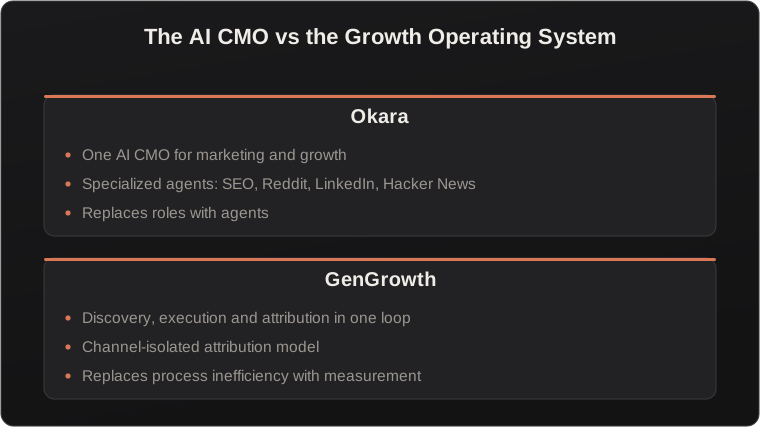
Okara frames growth as a distribution challenge, and its solution is a set of agents each dedicated to a distribution channel. GenGrowth frames growth as an engineering challenge, and its solution is an orchestrated growth loop that validates, executes, measures, and self-optimizes.
Reasoning: What Each Tool Prioritizes
Okara explicitly states on its website that "distribution is harder than building." This insight drives its feature set: Okara provides a dedicated AI agent for each major distribution channel — SEO & GEO, Reddit, LinkedIn, X/Twitter, Coding, UGC Videos, and Website Analysis. The tool also produces a Strategy Document. The promise is that with specialized agents working in parallel, you can cover the full distribution spectrum without hiring individual specialists.
GenGrowth takes a different starting point: it is positioned as an "Automated Growth Operating System." Its core capabilities — Auto Discovery, Strategy Engine, Execution Orchestration, Attribution Loop, Self-Optimization, and Governance & Compliance — reveal a system designed to manage the full growth process rather than just distribute content. A notable differentiation is the inclusion of Social-First validation: before scaling SEO efforts, GenGrowth tests topic demand by posting on Reddit or X to confirm there's a real audience need.
Scenario-based Advice
- Choose Okara if: You already have a product-market fit and simply need to distribute content across as many channels as possible, as fast as possible. The agent model assumes you know the messages; Okara helps broadcast them.
- Choose GenGrowth if: You're uncertain which channels or topics will perform, and you need a system that will test hypotheses, measure true contribution (via channel-isolated attribution), and scale only the highest-performing channels.
3. Pricing and Value: $99/mo Can Mean Very Different Things
Core Conclusion
Both tools offer entry-level pricing near $99/mo, but the features included differ significantly. Okara's free tier is a genuine free trial; GenGrowth's $99 Starter plan is discovery-only. The value inflection point occurs at GenGrowth's Pro ($199/mo) tier, which adds execution.
Reasoning: What You Get for $99/mo
Okara offers its Free AI CMO tier at $0 (no credit card required), granting 5 credits — roughly 50 messages. Its main paid tier, the AI CMO, costs $66/mo when paid annually, including 2,000 credits per month (approximately 20,000 messages). The core pricing narrative is aggressive: they claim to replace a $14,000/mo full marketing team ($5,000 for a full-time hire, $4,000 for an SEO agency, $1,500 for a content writer, $1,500 for a social media manager, $1,000 for community growth) for $99/mo.
GenGrowth uses a three-tiered pricing model:
| Tier | Price | Core Features |
|---|---|---|
| Starter | $99/mo | Auto opportunity discovery, Strategy generation with scoring, Weekly discovery reports, 1 product |
| Pro (Most Popular) | $199/mo | Everything in Starter + Automated execution (SEO/Social/Link), Channel-isolated attribution, Self-optimization loop, Social-First validation, 3 products |
| Growth | $299/mo | Everything in Pro + Unlimited products, Playbook cross-product reuse, Competitor monitoring, Custom execution templates |
GenGrowth offers a 14-day free trial for all tiers, with full features and no credit card required.
Cautions
- Okara's $99/mo value narrative assumes the tool can fully replace the listed roles, which depends heavily on your execution complexity and quality requirements.
- GenGrowth's $99 Starter plan does not execute anything; it only generates opportunities and strategies. True value begins at the $199 Pro tier.
4. Attribution and Measurement: A Fundamental Difference
Core Conclusion
Attribution is where the two approaches diverge most significantly. GenGrowth invests heavily in proving where growth comes from; Okara's approach centers on coverage rather than measurement.
Reasoning: Channel Isolation vs. Coverage
GenGrowth explicitly positions its UTM fingerprinting + channel-isolated attribution as a unique differentiator — stating on its website that no competitor offers this capability. This means that if the tool executes SEO, social, and link-building tasks, it can isolate which channel drove which outcome. The data integrity layer is described as "6-dimension."
Okara, by contrast, offers a "Strategy Document" agent and specialized distribution agents, but it does not prominently feature attribution or measurement infrastructure. The tool is designed to ensure your content appears across many channels; it does not claim to measure which channel actually drives the revenue.
Practical Recommendation
- For data-driven teams: GenGrowth's Pro tier is the safer choice. The combination of automated execution + channel-isolated attribution creates a feedback loop where you know what's working and can allocate budget accordingly.
- For pre-revenue or early-stage products: Okara may be sufficient. If you cannot yet measure sophisticated attribution, having coverage across Reddit, LinkedIn, and Hacker News may be more valuable than knowing which channel drove the most conversions.
5. Key Comparison Table
| Dimension | Okara | GenGrowth |
|---|---|---|
| Core Positioning | AI CMO — one tool to replace the entire marketing team | Automated Growth Operating System — a process for scalable growth |
| Distribution Philosophy | Multi-agent, multi-channel broadcast | Orchestrated execution with validation and self-optimization |
| Attribution | Not explicitly featured | Channel-isolated UTM fingerprinting (claimed unique) |
| Social-First Validation | No | Yes — tests topics on Reddit/X before SEO scaling |
| Free Offering | $0 tier (5 credits) | 14-day free trial (all features) |
| Entry Price | $66/mo (annual, 2,000 credits) | $99/mo (Starter, discovery only) |
| Value Inflection Price | $66/mo | $199/mo (Pro, includes execution) |
| Best for | Broad distribution, role replacement | Measurable growth, data-driven teams |
6. FAQ
Q1. Which tool is better for a solo founder without a growth background?
Okara may be easier to start with. Its onboarding claim is that agents start working minutes after adding a website. GenGrowth requires more upfront setup (defining products, strategy, and execution rules) and assumes some growth process knowledge. However, GenGrowth's FAQ explicitly states that while Okara (and BabyLoveGrowth) give "advice" at the $99 price point, GenGrowth's Pro/Growth tiers add automated execution and channel-isolated attribution. If the founder can afford $199/mo and wants a system that teaches them what works, GenGrowth is the more powerful choice.
Q2. Do both tools support B2B and B2C use cases?
Yes, both tools are designed for general growth. However, GenGrowth's Social-First validation — testing topic demand on Reddit and X before committing to SEO effort — is particularly useful for B2B audiences who congregate on those platforms. Okara's agent suite, which includes LinkedIn and X/Twitter in addition to Reddit, makes it arguably more suitable for B2B also, since LinkedIn is a primary B2B channel.
Q3. Which tool has better GEO (Generative Engine Optimization) support?
Okara explicitly includes "SEO & GEO" as one of its agents, making GEO a first-class citizen in its agent suite. It also integrates with Hacker News, a commonly overlooked GEO signal source. GenGrowth does not explicitly label GEO as a separate feature, but its SEO execution and Social-First validation may indirectly improve GEO performance by ensuring content is discoverable by AI search engines.
7. Conclusion
The choice between Okara and GenGrowth ultimately depends on your growth maturity and what you need AI to do for your business:
- If your priority is speed and breadth of distribution — if you know your product and your message, and just need to appear everywhere — Okara's agent suite offers a low-friction path to multi-channel presence. The free tier is also a genuine way to test the approach without risk.
- If your priority is building a repeatable, measurable growth system — if you need to validate which channels work, attribute results, and continuously self-optimize — GenGrowth's Pro tier is the stronger investment. The channel-isolated attribution and Social-First validation create a defensible growth loop.
Neither tool is universally "better." Both are legitimate responses to the AI CMO challenge, but they serve different needs. For the founder who wants to outsource distribution at low cost, Okara is compelling. For the founder who wants to build a data-driven growth engine, GenGrowth's process orientation is likely to generate higher long-term value.
Next step: If your budget allows, take advantage of both free trials. Test Okara for two weeks with its free tier (or $66/mo paid plan) and GenGrowth's 14-day free trial for the Pro tier. After 30 days, compare actual outcomes — coverage, attribution data, and revenue impact — and choose the approach that delivered real growth, not just activity.
Sources
GenGrowth Team
Growth Automation Engineers
We build tools that help product teams automate growth experiments.
Related Articles
- methodologyGenGrowth vs Blaze: AI Growth Automation vs AI Content CreationMarketing teams and founders today face a noisy landscape of AI tools promising to replace manual work. Two distinct approaches have emerged: AI content creation and AI growth automation.
- methodologyThe Best AI Marketing and CMO Tools for SaaS in 2026SaaS marketing teams in 2026 face a fragmented landscape: disconnected analytics, manual campaign management, and growing pressure to do more with fewer resources.
- methodologyAI Marketing Automation for SaaS: From Content to ConversionSaaS marketing teams face a persistent challenge: bridging the gap between producing content and driving conversions.