 GenGrowth
GenGrowth vs Cometly: AI Growth Automation vs Ad Attribution
Marketing teams increasingly face two intertwined challenges: understanding exactly which ad dollars drive revenue, and automating the entire growth cycle from discovery to optimization.
Key Takeaways
- GenGrowth is an end-to-end AI growth automation system that includes discovery, strategy, execution, and attribution, while Cometly is a dedicated ad attribution tool for B2B SaaS.
- Cometly specializes in first-party, cookieless attribution with 70+ integrations and granular multi-touch models, citing a +31% ad return lift at ClickFunnels and a +40% improvement at Trainual.
- GenGrowth’s Attribution Loop uses channel-isolated UTM fingerprints and channel conflict detection, but attribution is just one stage in a broader automation pipeline that includes Auto Discovery, Strategy Engine, and Self-Optimization.
- Cometly costs $750/month (Core plan) with a one-time $1,500 onboarding fee; GenGrowth’s pricing is not publicly listed in available sources.
- For teams focused solely on measuring ad-to-revenue attribution, Cometly is purpose-built; for teams seeking an automated growth engine that also handles attribution, GenGrowth offers a more holistic approach.
1. Introduction
Marketing teams increasingly face two intertwined challenges: understanding exactly which ad dollars drive revenue, and automating the entire growth cycle from discovery to optimization. Two tools have emerged to address these needs from different angles: Cometly, a marketing attribution platform purpose-built for B2B SaaS, and GenGrowth, an AI-driven growth automation system that treats attribution as one component of a larger workflow.
This article compares the two solutions across product philosophy, attribution depth, integrations, pricing, and use-case fit. The goal is to clarify what each tool delivers so you can decide which one—or whether a combination—serves your growth stack. All claims are drawn from verified vendor sources and customer-reported results.
2. Core Product Philosophy: Standalone Attribution vs. End-to-End Automation
Conclusion: Cometly is a specialized attribution tool; GenGrowth is a full growth automation platform where attribution is embedded but not the main focus.
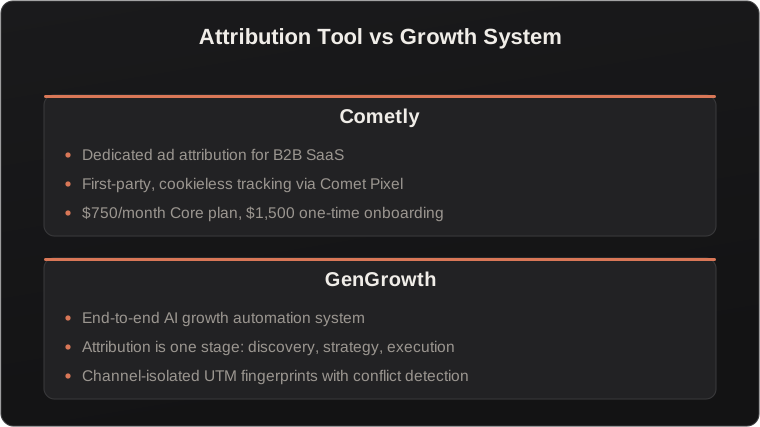
Cometly describes itself as marketing attribution software that ties ad spend to closed-won ARR and pipeline revenue. It uses a first-party, cookieless server-side pixel (Comet Pixel) with fingerprint-based cross-device stitching, designed to survive ad blockers and iOS privacy limits. The entire product is optimized for one job: giving B2B SaaS marketers a clear, multi-touch view of which campaigns and channels contribute to revenue.
GenGrowth, by contrast, positions attribution as one stage of an end-to-end system. Its Attribution Loop tracks every executed action with channel-isolated UTM fingerprints (using utm_term = agent_id_batch_id) and channel conflict detection for clean per-channel measurement. But this attribution layer is paired with Auto Discovery, a Strategy Engine, Execution Orchestration, and a Self-Optimization loop. In other words, GenGrowth doesn’t just measure; it also discovers what to do, creates strategies, executes campaigns, and optimizes them automatically.
Scenario guidance:
- If your primary pain point is “I can’t tell which ad platform drives pipeline revenue,” Cometly’s single-minded focus is a strength.
- If your team needs an autonomous growth system that finds opportunities, runs tests, and adjusts without manual handoffs, GenGrowth’s broader scope may save significant operational overhead.
3. Attribution Capabilities: Depth vs. Context
Conclusion: Cometly offers richer, more flexible attribution models and advanced cross-device tracking; GenGrowth’s attribution is simpler but tied to closed-loop automation.
Cometly supports multiple attribution models: first touch, last touch, last non-direct, linear, linear paid, and U-shaped. These models can be compared across windows from 1 day to lifetime. The Comet Pixel’s server-side deployment and fingerprint stitching mean it works even when traditional pixels fail, a crucial advantage for B2B SaaS companies facing iOS ad limits. Cometly also reports a Meta Conversion API match quality of up to 9.3/10.
GenGrowth’s Attribution Loop uses UTM-based fingerprints that are isolated per channel and includes conflict detection to prevent double-counting when multiple touchpoints compete. However, available sources do not disclose multiple attribution models or a cross-device stitching method comparable to Cometly’s. GenGrowth’s strength lies not in granular model selection but in the fact that attribution data feeds directly back into its Self-Optimization loop: the system can automatically shift budget or content based on what the attribution shows.
Recommendation: For teams that need deep, customizable attribution analytics to report to stakeholders or optimize ad spend manually, Cometly provides more flexibility. For teams that want attribution to trigger automated actions without manual analysis, GenGrowth’s integrated approach is more efficient.
4. Integrations and Data Syncs
Conclusion: Cometly offers more native integrations and data warehouse support; GenGrowth’s integration ecosystem is not detailed in the available evidence.
Cometly advertises 70+ native integrations and syncs paying-customer events back to ad platforms including Meta, Google, Microsoft, LinkedIn, and TikTok. For enterprises needing centralized data, Cometly supports exports and live syncs to Snowflake, BigQuery, and Redshift, plus an MCP server for AI agents.
GenGrowth’s official features page mentions channel conflict detection and UTM-based tracking, but available evidence does not specify the number of native integrations or warehouse syncs. Its automation architecture suggests it likely connects to major ad platforms, but the lack of published detail means users should verify with GenGrowth directly.
Practical advice: If your stack already relies on Snowflake or BigQuery, Cometly’s direct syncs are a clear advantage. If you need to pipe attribution data into an AI agent system, Cometly’s MCP server is a differentiator.
5. Pricing and Onboarding
| Feature | Cometly (Core Plan) | GenGrowth |
|---|---|---|
| Monthly price | $750/month | Not disclosed |
| Included sessions | 50,000/month | Not disclosed |
| Seats | 5 | Not disclosed |
| One-time fee | $1,500 Professional Onboarding | Not disclosed |
| Free trial | No | Not disclosed |
Source: Cometly pricing page
Cometly’s Core plan requires a $1,500 onboarding fee and has no free trial. GenGrowth’s pricing is not available in the verified evidence; interested buyers should request a quote. Note that Cometly’s pricing does not cover all session volumes or team sizes; upper-tier plans likely cost more.
Caveat: The lack of GenGrowth pricing data makes it impossible to conduct a direct cost comparison. For budget-conscious teams, Cometly’s upfront cost is known, while GenGrowth requires a sales conversation.
6. FAQ
Q1. Can I use GenGrowth just for attribution, without its other automation features?
Based on available information, GenGrowth positions attribution as one stage of an end-to-end system. While you may be able to focus on the Attribution Loop, the platform is designed to run the full growth cycle. If you only need attribution, Cometly might be a more focused and potentially lower-cost choice.
Q2. Which tool handles ad blockers and iOS privacy better?
Cometly uses a first-party, cookieless server-side pixel with fingerprint-based cross-device stitching that survives ad blockers and iOS limits. GenGrowth’s UTM-based tracking is server-side as well, but its ability to overcome iOS restrictions is not detailed in the evidence reviewed. Cometly has an explicit claim here.
Q3. Are the customer results (31% lift, 40% improvement) independently verified?
These results appear on Cometly’s homepage and are attributed to ClickFunnels (+31% ad return lift) and Trainual (+40% improvement in 90 days). The evidence does not indicate third-party audit. They should be treated as vendor-reported case studies rather than independent benchmarks.
Q4. Can Cometly and GenGrowth be used together?
In theory, yes. Cometly could serve as the dedicated attribution layer while GenGrowth handles discovery, strategy, and execution. However, this would involve overlapping attribution logic and potential data conflicts. Most teams would choose one primary attribution system to avoid double-counting.
7. Conclusion
The choice between GenGrowth and Cometly hinges on your team’s primary need.
- Choose Cometly if your core challenge is understanding which ad campaigns drive closed-won ARR and pipeline revenue, and you need rich multi-touch attribution models, cross-device tracking, and deep integrations with ad platforms and data warehouses. Cometly is a mature, specialized tool with known pricing and documented customer results.
- Choose GenGrowth if you want an AI-driven system that handles the entire growth process—discovery, strategy, execution, attribution, and self-optimization—in one loop. Attribution is a built-in feature rather than a standalone product, and the automation of subsequent actions may reduce manual work.
For many B2B SaaS teams, a pragmatic path is to start with a dedicated attribution tool (like Cometly) to validate measurement rigor, then layer in automation as the growth process matures. However, if you are building a growth stack from scratch and want a single system that learns and acts on its own, GenGrowth’s holistic design warrants a closer look.
This comparison is based on publicly available vendor information as of the knowledge cut-off date. Always conduct your own trials and consult updated pricing before making a purchasing decision.
Sources
GenGrowth Team
Growth Automation Engineers
We build tools that help product teams automate growth experiments.
Related Articles
- methodologyGenGrowth vs Improvado: Automated Growth vs Enterprise Marketing DataMarketing teams today face a fundamental tension: they need to automate growth experiments and campaigns quickly, yet they also need reliable, unified data to measure results across channels.
- methodologyMarketing Attribution for SaaS: Closing the Loop Between Spend and RevenueFor SaaS companies, every dollar of marketing spend carries an implicit question: Did this actually drive revenue? Answering that question with confidence has never been harder.
- methodologyThe 9 Best Marketing Attribution Tools for SaaS in 2026As SaaS companies fight for efficiency in 2026, accurate marketing attribution is no longer optional—it's the foundation for every spend decision.