 GenGrowth
Marketing Attribution for SaaS: Closing the Loop Between Spend and Revenue
For SaaS companies, every dollar of marketing spend carries an implicit question: Did this actually drive revenue? Answering that question with confidence has never been harder.

Key Takeaways
- The decline in cross-platform campaign measurement is the top concern for 43% of marketing professionals, driven largely by third-party cookie depreciation.
- 85% of advertising professionals are already pivoting to first-party data identifiers to handle the loss of cookies.
- Channel-isolated attribution—using UTM fingerprinting and automated data verification—eliminates the “spreadsheet guesswork” that plagues manual growth operations.
- Two proven approaches exist for SaaS: GenGrowth’s self-optimizing attribution loop (ideal for growth teams) and Cometly’s closed-won ARR attribution (purpose-built for B2B revenue teams).
- The right attribution strategy lets you know exactly where to double down, preventing wasted spend and enabling systematic scaling.
1. Introduction
For SaaS companies, every dollar of marketing spend carries an implicit question: Did this actually drive revenue? Answering that question with confidence has never been harder. In a November 2023 global survey, 43% of media and marketing professionals cited the decline in their ability to measure campaign effectiveness across tech platforms and the open web as their single most pressing concern. That number reflects a perfect storm: the phase-out of third-party cookies, fragmentation across ad platforms, and the inability to tie a Facebook click to a closed-won deal in a spreadsheet.
The industry is already responding. According to the same survey ecosystem, 85% of advertising professionals say they or their clients are now prioritizing first-party data identifiers to address cookieless traffic. First-party data is necessary, but it is not sufficient on its own. To close the loop between spend and revenue, SaaS marketers need an attribution system that physically isolates channels, automatically verifies data integrity, and surfaces which actions are truly generating pipeline—all before any scaling decision is made.
This article explains two concrete, verifiable approaches to achieving that loop: the channel-isolated automatic attribution model built by GenGrowth, and the server-side, revenue-focused attribution platform from Cometly. Both solve the core problem of attribution opacity, but they serve different SaaS use cases. By the end, you will know which approach fits your team’s growth model, and how to implement it without relying on guesswork.
2. The Attribution Crisis in SaaS
Why Traditional Models Are Breaking
SaaS buying cycles are long, multi-touch, and often involve anonymous research before a demo request. In that environment, last-click attribution massively undervalues top-of-funnel content and overvalues bottom-of-funnel direct channels. Meanwhile, multi-touch attribution models remain fragile: they depend on stitching user sessions together across devices and browsers, a practice that third-party cookie deprecation systematically erodes.
The result is what GenGrowth explicitly contrasts against manual growth operations: “spreadsheet guesswork, no clear attribution.” Teams export ad platform data, mix it with CRM sources, apply arbitrary weighting, and then make budget decisions based on spreadsheets that may double-count conversions or miss offline influence entirely. This approach not only wastes budget—it delays the signal needed to iterate campaigns in real time.
The First-Party Data Pivot
The shift to first-party data is not merely a compliance response; it is an opportunity to build a more disciplined attribution infrastructure. When you own the identifier (email, user ID, or unique UTM fingerprint), you control the attribution logic. You are no longer dependent on a platform’s view of the world.
But first-party data alone does not solve the core attribution problem: sources of truth still need to be isolated and verified. If a user clicks a LinkedIn ad and later visits your blog via organic search, which channel should receive the conversion credit? Without channel isolation, the answer is always an assumption.
3. How Channel-Isolated Attribution Works
UTM Fingerprinting and Physical Isolation
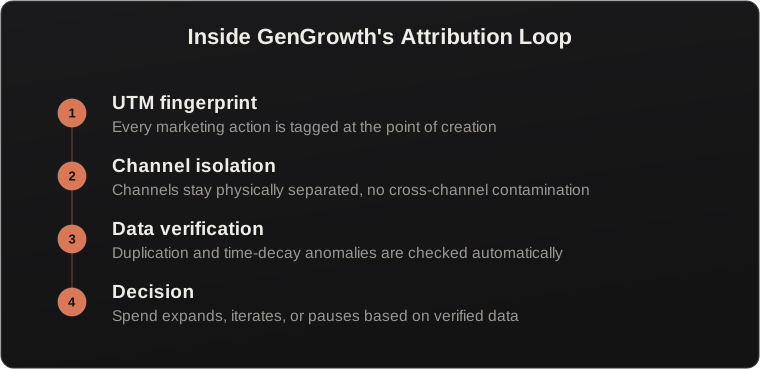
GenGrowth’s approach, which it calls the Attribution Loop, solves the isolation problem through a technical mechanism: every marketing action is assigned a UTM fingerprint before it reaches the potential customer. These fingerprints physically isolate channels from one another. The practical effect is that a sale or lead can be traced back to exactly one source—untouched by other platforms’ identifier-syncing or last-touch overwrites.
The workflow is described as follows:
- Every action receives a UTM fingerprint – Whether it’s an email campaign, a paid social ad, or a content syndication post, the UTM parameters are embedded at the point of creation.
- Channels are physically isolated – No cross-channel contamination. A user who enters through a UTM-tagged LinkedIn post will be attributed to that channel, regardless of what they do later in other sessions (unless the fingerprint explicitly allows multi-touch).
- Data integrity is automatically verified – Before the self-optimization layer decides to expand, iterate, or pause an initiative, GenGrowth checks that the attribution data is consistent and free of duplication or time-decay anomalies.
- A decision is made – Based on verified data, the optimization tool adjusts spend or content focus.
This approach does not rely on cookies or cross-device stitching. It works with first-party identifiers and server-side data, making it resilient to cookie deprecation.
Server-Side Revenue Attribution: An Alternative Model
Cometly offers a different but complementary method. For B2B SaaS companies that need to tie ad spend directly to closed-won ARR, Cometly uses the Comet Pixel and server-side tracking. Its key innovation: it sends closed-won revenue back to ad platforms (Meta, Google, LinkedIn, Microsoft, TikTok) via Conversion API. This means the ad platform’s own optimization algorithms can learn which clicks lead to actual paying customers, not just sign-ups or demo requests.
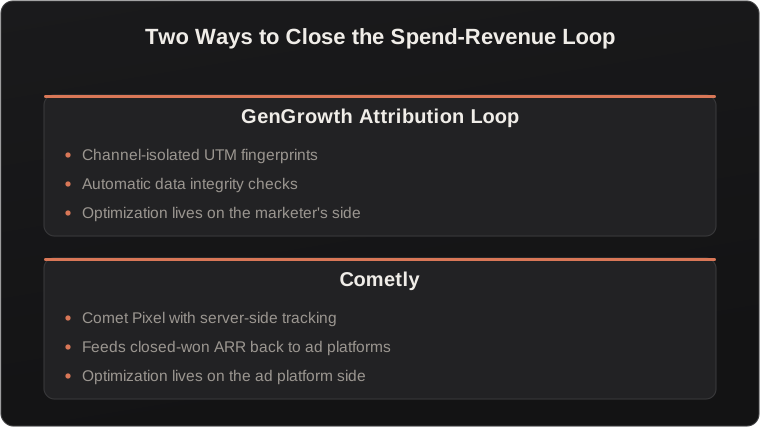
Both approaches share a core principle: attribution must be deterministic and verifiable before it is used to scale. The difference lies in where the attribution logic lives—on the marketer’s side (GenGrowth) or on the ad platform side (Cometly).
4. Practical Applications for B2B SaaS
Use Case 1: Growth Teams Running Multi-Channel Tests
A SaaS growth team launching a new product feature may run paid LinkedIn ads, email nurture sequences, and organic LinkedIn posts simultaneously. Without channel isolation, it is impossible to know which channel actually drove the demo requests.
Using GenGrowth’s loop, the team assigns a unique UTM fingerprint to each variant. After the campaign runs, they can see that the LinkedIn ad with “feature_abc” fingerprint generated 14 qualified opportunities, while the email with “feature_email” generated only 2. The self-optimization layer then increases LinkedIn spend and pauses the email variant—all based on verified, uncontaminated data. GenGrowth explicitly cites this for its e-commerce use case: “attributes every sale to its growth channel so teams know exactly where to double down.”
Use Case 2: B2B Revenue Teams Measuring Closed-Won ARR
For companies selling $50k+ ACV contracts, the cost of a bad attribution decision is enormous. Cometly’s platform feeds closed-won ARR back to the ad platforms. If a Facebook campaign generated three $100k deals and a LinkedIn campaign generated one $50k deal, the Conversion API tells Facebook that its ads drove $300k in ARR, while LinkedIn gets $50k. The ad platforms then redirect budget toward the higher-performing channel automatically.
Which Approach Should You Choose?
| If your priority is… | Use… |
|---|---|
| Multi-touch campaign iteration across many small channels | GenGrowth’s Attribution Loop (channel isolation, self-optimization) |
| Direct B2B revenue attribution with ad platform optimization | Cometly (server-side, closed-won ARR) |
| Avoiding any cookie-based tracking | Both are cookieless-compatible; GenGrowth relies on UTM fingerprints, Cometly on server-side pixels |
| Enterprise-level data governance and auditability | GenGrowth’s automatic data verification before decision-making |
5. Key Comparison: GenGrowth vs Cometly
| Feature | GenGrowth | Cometly |
|---|---|---|
| Core attribution mechanism | UTM fingerprinting with physical channel isolation | Comet Pixel + server-side Conversion API |
| Primary attribution target | Sale, lead, or any conversion (custom) | Closed-won ARR |
| Data verification | Automatic data integrity check before any decision | Relies on server-side event accuracy |
| Platform integration | UTM-based, works with any destination | Native: Meta, Google, LinkedIn, Microsoft, TikTok |
| Best suited for | Growth teams running many small channels | B2B revenue teams with long sales cycles |
| Self-optimization | Yes – the loop decides to expand, iterate, or pause | No – platform-optimization via Conversion API |
6. FAQ
Q1. How does channel isolation improve attribution accuracy compared to last-click or multi-touch models?
Channel isolation prevents conversion credit from being “contaminated” by other marketing activities. In a last-click model, if a user clicks a direct link after seeing a LinkedIn ad, LinkedIn gets zero credit. In a multi-touch model, the credit is often split arbitrarily. With physical isolation via UTM fingerprinting, the originating channel retains full attribution for that user’s first touch, regardless of subsequent clicks. This gives a clear, auditable signal for which channel initiated the buying journey.
Q2. Is first-party data alone enough for SaaS attribution after cookie deprecation?
No. First-party data (e.g., email addresses, logged-in user IDs) provides a stable identifier, but it does not solve the problem of attributing that identifier to a specific marketing channel. Without a method like UTM fingerprinting or server-side tracking, you still cannot determine whether a logged-in user arrived from a Google ad or an organic search. The 85% of advertising professionals moving to first-party data identifiers are taking an essential first step, but they still need a system that attaches those identifiers to channel-level attribution.
Q3. Which tool should a B2B SaaS company choose: GenGrowth or Cometly?
It depends on your model. If your SaaS company sells a product with a short sales cycle (e.g., self-serve, under $500/mo), GenGrowth’s channel-isolated attribution loop will help you iterate quickly across many channels. If you sell to enterprise buyers and need to prove which ad creatives are generating multi-thousand-dollar ARR, Cometly’s closed-won ARR attribution gives the clearest signal to ad platform algorithms. The two are not mutually exclusive—some teams use GenGrowth for top-of-funnel campaign iteration and Cometly for bottom-of-funnel revenue tracking.
7. Conclusion
Marketing attribution for SaaS is no longer a “nice-to-have.” With 43% of marketing professionals naming measurement decline as their top concern, and 85% already pivoting to first-party data, the window for implementing a reliable attribution system is closing for those who still rely on ad-platform silos and spreadsheets.
The two approaches described here—GenGrowth’s channel-isolated automatic attribution loop and Cometly’s server-side ARR attribution—both close the loop between spend and revenue in a verifiable, auditable way. The first gives growth teams the agility to test and scale campaigns without cross-channel contamination; the second gives B2B revenue teams the precision to prove ROI in dollar terms to the ad platforms.
Whichever path you choose, the principle is the same: don’t decide based on assumptions. Implement channel isolation, verify your data before scaling, and let the numbers tell you where to double down. Your marketing budget—and your board—will thank you.
Sources
- www.globenewswire.com/news-release/2023/04/29/2657968/0/en/Marketing-Attribution-Software-Market-Anticipated-to-Garner-USD-12-4-Billion-at-a-CAGR-of-13-50-by-2030-Report-by-Market-Research-Future-MRFR.html
- www.statista.com/statistics/1344811/marketing-concerns
- www.statista.com/statistics/1184683/solutions-replace-cookies
- improvado.io/integrations
- www.cometly.com/pricing
- improvado.io/pricing
- improvado.io/products/ai-agent
GenGrowth Team
Growth Automation Engineers
We build tools that help product teams automate growth experiments.
Related Articles
- methodologyGenGrowth vs Improvado: Automated Growth vs Enterprise Marketing DataMarketing teams today face a fundamental tension: they need to automate growth experiments and campaigns quickly, yet they also need reliable, unified data to measure results across channels.
- methodologyGenGrowth vs Cometly: AI Growth Automation vs Ad AttributionMarketing teams increasingly face two intertwined challenges: understanding exactly which ad dollars drive revenue, and automating the entire growth cycle from discovery to optimization.
- methodologyThe 9 Best Marketing Attribution Tools for SaaS in 2026As SaaS companies fight for efficiency in 2026, accurate marketing attribution is no longer optional—it's the foundation for every spend decision.