 GenGrowth
GenGrowth vs Improvado: Automated Growth vs Enterprise Marketing Data
Marketing teams today face a fundamental tension: they need to automate growth experiments and campaigns quickly, yet they also need reliable, unified data to measure results across channels.
Key Takeaways
- GenGrowth offers transparent, self-serve pricing ($99‑$299/month) and a 14‑day free trial with no credit card, making it accessible for small‑to‑mid‑sized teams focused on automated growth loops.
- Improvado positions itself as an enterprise‑grade AI agent that connects, analyzes, creates, and optimizes marketing data from 500+ sources, with custom pricing and strong compliance credentials (SOC 2 Type II, HIPAA, GDPR, CCPA).
- GenGrowth’s Attribution Loop uses unique UTM fingerprints and enforces channel isolation between SEO and social traffic, while Improvado relies on a knowledge graph for multi‑channel attribution linking spend, ad performance, and pipeline.
- Improvado targets large organizations and agencies in regulated industries (healthcare, finance, retail); GenGrowth is built for lean growth teams that want a complete, automated growth cycle with built‑in governance.
- The right choice depends on your budget, need for enterprise compliance, data integration complexity, and whether you prioritize automated growth execution or centralized data orchestration.
1. Introduction
Marketing teams today face a fundamental tension: they need to automate growth experiments and campaigns quickly, yet they also need reliable, unified data to measure results across channels. Many tools excel at one side but struggle with the other. Two platforms that represent opposite ends of this spectrum are GenGrowth and Improvado.
GenGrowth is designed as an automated growth machine — it discovers opportunities, generates strategies, executes campaigns, and optimizes itself in a closed loop. Improvado, on the other hand, is an enterprise marketing data platform that ingests data from 500+ sources, enriches it, and uses an AI agent to analyze and act on it.
This article compares GenGrowth and Improvado across pricing, core capabilities, attribution models, compliance, and target users. By the end, you will have a clear framework for deciding which tool fits your team’s size, maturity, and growth goals.
2. Pricing and Accessibility: Transparent Self‑Serve vs. Custom Enterprise Quotes
Core conclusion: GenGrowth offers predictable, low‑commitment pricing that lets any team start immediately, while Improvado requires a sales conversation and is tailored for larger budgets.
GenGrowth publishes three plan tiers on its website: Starter at $99/month, Pro at $199/month, and Growth at $299/month — all with a 14‑day free trial that gives full access without requiring a credit card. This transparency removes friction for small teams or startups that want to test automated growth without financial risk.
Improvado lists three plan tiers named Growth, Advanced, and Enterprise, but none display public prices. To get a quote, users must book a demo or contact sales. This model is typical for enterprise solutions that require customized scoping, dedicated support, and often higher commit levels.
Scenario advice:
- If you are a solo marketer, a startup, or a small agency with a fixed monthly budget, GenGrowth’s self‑serve pricing allows you to start and scale without negotiation.
- If you are a large enterprise or a heavily regulated organization that needs a robust data pipeline and a dedicated account team, Improvado’s custom pricing is appropriate — but be prepared for a longer sales cycle and a higher total cost.
3. Core Capabilities: Automated Growth Loop vs. Enterprise Data Centralization
Core conclusion: GenGrowth focuses on executing the full growth cycle from discovery to optimization, whereas Improvado prioritizes connecting and analyzing data from diverse sources to inform marketing decisions.
GenGrowth’s platform is built around six integrated capabilities: Auto Discovery, Strategy Engine, Execution Orchestration, Attribution Loop, Self‑Optimization, and Governance & Compliance. Together, these cover the entire growth loop — the system automatically identifies growth levers, decides on strategies, deploys campaigns across channels, tracks results with precise attribution, optimizes performance, and enforces governance rules. This makes it a self‑contained growth engine for teams that want to automate experimentation and execution without manual data wrangling.
Improvado’s value proposition is data centralization. It connects to 500+ marketing and sales data sources, ingests raw data, normalizes it, and presents it in a unified view. On top of this data layer, Improvado positions itself as “The AI Agent That Connects, Analyzes, Creates & Optimizes” — meaning it uses the integrated data to generate insights, create content, and optimize campaigns. However, its primary strength remains data integration and visualization for enterprise marketing teams that struggle with fragmented sources.
Scenario advice:
- Choose GenGrowth if your main pain point is automating growth experiments and you need a tool that handles everything from idea to execution and attribution.
- Choose Improvado if you already have execution tools but need a reliable, compliant way to unify data from many channels and then have AI act on that unified data.
4. Attribution Approaches: UTM Fingerprints with Channel Isolation vs. Knowledge Graph
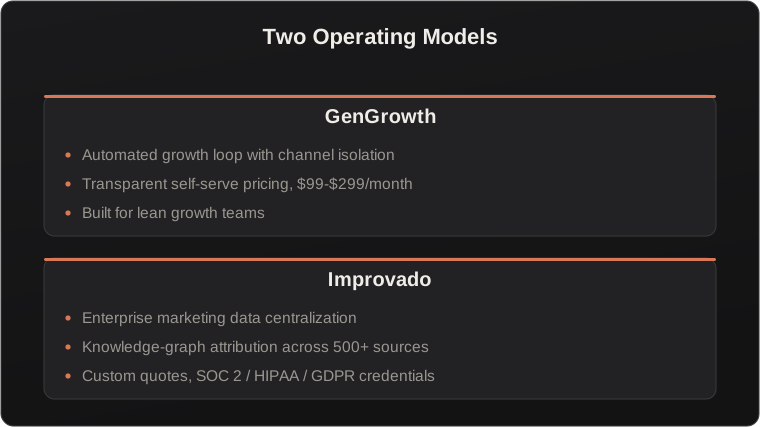
Core conclusion: GenGrowth enforces strict channel isolation using unique UTM fingerprints, while Improvado uses a knowledge graph to connect spend, ad performance, and pipeline for multi‑channel attribution.
Accurate attribution is critical for growth teams to know which channels and campaigns are driving revenue. GenGrowth’s Attribution Loop addresses a common problem — cross‑channel interference — by tagging every action with a unique UTM fingerprint and physically separating SEO traffic from social traffic. This channel isolation means you can trust that a conversion attributed to a social campaign was not contaminated by a concurrent organic search visit.
Improvado’s multi‑channel attribution works differently. It builds a knowledge graph that links marketing spend, ad performance metrics, and sales pipeline data to determine which campaigns actually influenced pipeline. This approach is better suited for complex, long‑sales‑cycle environments where touchpoints span weeks or months and require joining data from CRM, ad platforms, and analytics tools.
Scenario advice:
- If your growth model relies on short‑cycle, channel‑specific experiments (e.g., A/B testing different social ads vs. organic content), GenGrowth’s attribution with isolation gives you clean, actionable data.
- If you need to attribute revenue across a long funnel with many touches (e.g., enterprise B2B sales), Improvado’s knowledge graph can stitch together fragmented data sources to reveal the true impact.
5. Compliance and Enterprise Readiness
Core conclusion: Improvado provides mature compliance certifications and enterprise security features, while GenGrowth offers governance and compliance capabilities but does not publicly list certifications like SOC 2 or HIPAA.
Improvado is SOC 2 Type II certified and supports HIPAA, GDPR, and CCPA compliance. It also offers role‑based access, full audit trails, SSO/SAML, and EU data residency options. These features make it a natural fit for enterprises in healthcare, finance, retail, and other regulated industries.
GenGrowth includes a Governance & Compliance capability as part of its six‑feature set, but the available evidence does not specify which certifications or standards it meets. It likely provides compliance guardrails (e.g., permission controls, audit logs) appropriate for growth teams, but for heavily regulated environments, Improvado’s documented certifications give it a clear advantage.
Scenario advice:
- If you handle sensitive customer data (health records, financial transactions) or are required to meet HIPAA/SOC 2 compliance, Improvado is the safer choice.
- If your compliance needs are standard (e.g., GDPR for European users) and you mainly need automated governance within the growth loop, GenGrowth may still suffice — but verify its specific certifications with the vendor.
6. Key Comparison Table
| Feature | GenGrowth | Improvado |
|---|---|---|
| Pricing model | Self‑serve: $99‑$299/month; 14‑day free trial (no credit card) | Custom quotes; three tiers (Growth, Advanced, Enterprise); contact sales |
| Core purpose | Automated growth loop (discovery → strategy → execution → attribution → optimization → governance) | Data centralization from 500+ sources + AI agent for analysis and optimization |
| Attribution method | Unique UTM fingerprint + channel isolation (SEO/social separated) | Knowledge graph linking spend, ad performance, and pipeline data |
| Compliance certifications | Governance & Compliance capability (no public certifications listed) | SOC 2 Type II, HIPAA, GDPR, CCPA, SSO/SAML, EU data residency |
| Target users | Lean growth teams, startups, small‑mid agencies | Enterprise organizations, agencies in regulated industries (healthcare, finance, retail, etc.) |
| Trial / onboarding | Instant self‑serve, no sales contact needed | Requires demo/sales meeting |
7. FAQ
Q1. Which tool is better for a small startup with limited budget?
A: GenGrowth. Its public pricing starts at $99/month with a free trial that requires no credit card, making it low‑risk and budget‑friendly. Improvado’s custom pricing typically suits larger companies with bigger budgets.
Q2. Can Improvado handle automated campaign execution like GenGrowth?
A: Improvado claims to “create & optimize” through its AI agent, but its primary strength is data integration and analysis. GenGrowth is designed from the ground up as an automated growth engine with execution orchestration as a core feature. If your main need is automated execution of growth experiments, GenGrowth is more purpose‑built.
Q3. How do their attribution models differ for a multi‑channel e‑commerce business?
A: Both can handle multi‑channel attribution, but in different ways. GenGrowth attaches unique UTM fingerprints to each action and physically separates traffic from different channels (e.g., SEO vs. social), giving you clean, isolated attribution. Improvado uses a knowledge graph that joins spend, ad performance, and pipeline data, which works well for long, complex funnels where multiple touches overlap. For a short‑cycle e‑commerce business, GenGrowth’s isolation method may produce clearer results; for a B2B e‑commerce model with long sales cycles, Improvado’s graph approach is more suitable.
8. Conclusion
GenGrowth and Improvado serve different marketing maturity levels and use cases. GenGrowth is the right choice when you want a self‑contained, automated growth loop with transparent pricing, simple attribution, and a no‑fuss trial. It fits lean teams that need to run experiments quickly and trust their attribution data.
Improvado excels when your biggest challenge is data fragmentation across 500+ sources, and you require enterprise‑grade compliance (SOC 2, HIPAA, GDPR) for handling sensitive data. It is built for larger organizations and agencies that can invest in a custom‑priced platform and are willing to go through a sales process.
Assess your priorities: if automated growth execution and low cost of entry matter most, start with GenGrowth. If unified enterprise data and compliance are non‑negotiable, explore Improvado. Neither is universally “better” — the right fit depends on your team size, growth strategy, and regulatory environment.
Sources
GenGrowth Team
Growth Automation Engineers
We build tools that help product teams automate growth experiments.
Related Articles
- methodologyMarketing Attribution for SaaS: Closing the Loop Between Spend and RevenueFor SaaS companies, every dollar of marketing spend carries an implicit question: Did this actually drive revenue? Answering that question with confidence has never been harder.
- methodologyGenGrowth vs Cometly: AI Growth Automation vs Ad AttributionMarketing teams increasingly face two intertwined challenges: understanding exactly which ad dollars drive revenue, and automating the entire growth cycle from discovery to optimization.
- methodologyThe 9 Best Marketing Attribution Tools for SaaS in 2026As SaaS companies fight for efficiency in 2026, accurate marketing attribution is no longer optional—it's the foundation for every spend decision.