 GenGrowth
Multiple Pages Ranking for the Same Keyword — What Seven Competing URLs Cost Us, in Numbers
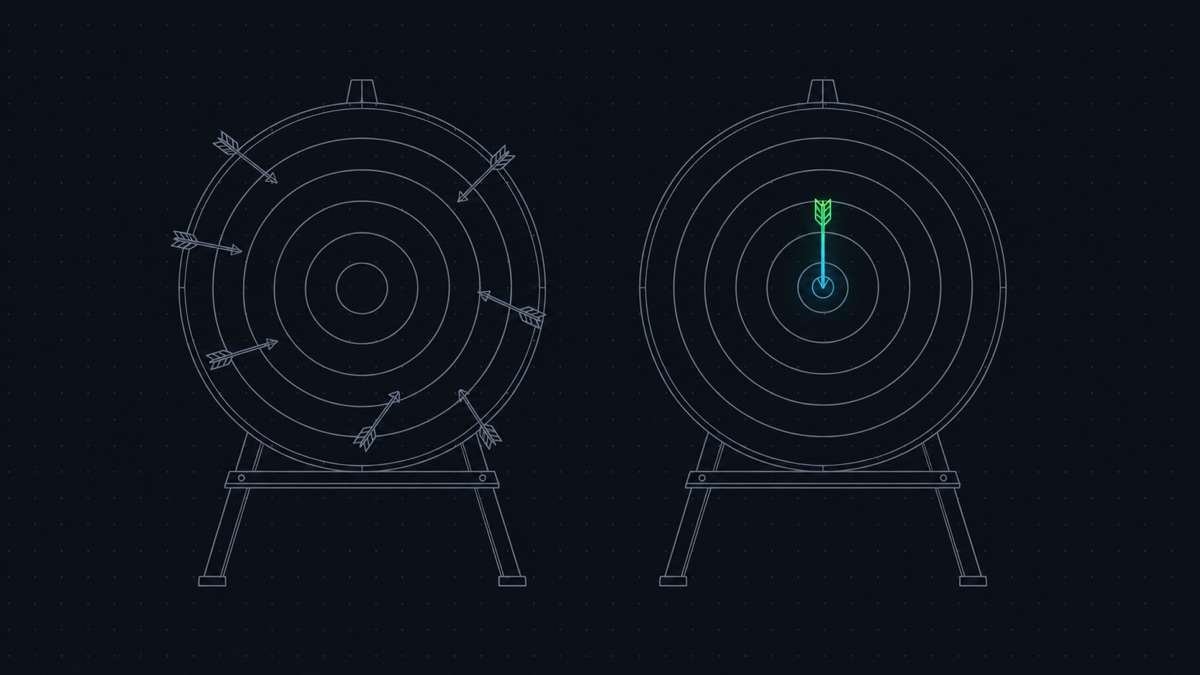
Seven pages on our own site aimed at one commercial intent — cheap and low-cost SEO tools — pulled 2,318 impressions and 2 clicks over a three-month Search Console window ending 10 August 2026, and no substantive page among them reached the top 15.
What Is Keyword Cannibalization, and What Do Multiple Pages Ranking for the Same Keyword Cost?
Seven pages on our own site aimed at one commercial intent — cheap and low-cost SEO tools — pulled 2,318 impressions and 2 clicks over a three-month Search Console window ending 10 August 2026, and no substantive page among them reached the top 15. This pattern has a name, keyword cannibalization, and most write-ups define it without ever publishing what it costs. Here is our own bill, from the same export workflow described in the pillar on reading your own Search Console data.
- The strongest page collected 1,258 impressions at an average position of 29.8 — page three, where clicks rarely happen.
- Two more pages split another 1,005 impressions at positions 19.9 and 24.1; three stragglers scattered most of the rest between positions 37 and 48.
- One page technically ranked at position 6.5 — on 2 impressions. A good average position on a query almost nobody makes is not a ranking; it is a rounding error.
- The same audit found three more sizable clusters with the same shape: four pages splitting 1,595 impressions (2 clicks), three pages splitting 895 (0 clicks), six pages splitting 465 (0 clicks).
Twenty pages across the four sizable clusters, roughly 5,300 impressions, 4 clicks. That is what "multiple pages ranking for the same keyword" looks like from inside the Search Console export — mostly, pages not ranking for it.
Why It Matters When Pages Ranking for the Same Keyword Split the Signal
Google's 2019 site-diversity change means results usually show no more than two listings from the same site for a query — "you usually won't see more than two listings from the same site in our top results," as Search Engine Land reported Google's announcement — so the engine has to choose among your candidates. For overlapping content, Google Search Central's documentation on duplicate consolidation describes Google picking one canonical to represent the set, and its canonicalization guidance states the canonical is crawled most regularly while duplicates are crawled less frequently. Its overview of how search results are generated describes ranking as weighing many signals per result. What our own data suggests happens when one site fields seven overlapping candidates: no single one accumulates enough signal to compete.
Seven candidates for one intent means the choice signals — links, engagement, internal anchors — split seven ways, and no single page accumulates enough weight to compete. Your internal linking splits the same way: every mention of the topic across your site has seven possible destinations, so the equity that could concentrate on one URL dilutes across the set — how that dilution works is covered in how internal link structure moves authority.
The result is not seven pages ranking. It is zero pages ranking, with the impressions to prove it.
How Multiple Pages Ranking for the Same Keyword Look in Search Console Data
The numbers above are the summary. The page-level data is where the pattern becomes visible.
The Cluster That Split Seven Ways
According to our own Search Console export, the cheap-SEO-tools cluster broke down like this over the window:
- The strongest candidate held 1,258 impressions at an average position of 29.8.
- Two challengers split 583 impressions (position 19.9) and 422 (position 24.1).
- Four stragglers collected 35, 15, 3 and 2 impressions each, from position 37.2 down to 47.7 — apart from the 2-impression page that averaged 6.5.
Visibility ended up spread across candidates instead of concentrating on one — three different pages each collected hundreds of impressions, and none converted that into a stable top-15 position.
Three More Clusters, Same Shape
The same site audit found an SEO-reports cluster (4 pages, 1,595 impressions, 2 clicks), a white-label-SEO cluster (3 pages, 895 impressions, 0 clicks), and a SaaS-SEO cluster (6 pages, 465 impressions, 0 clicks), plus a fifth, negligible cluster at 8 total impressions. Four independent topic families, one identical signature: impressions spread across competing pages, click-through effectively zero — the audit put the site's abandoned-positioning content as a whole between positions 20 and 90.
The Control Group on the Same Domain
In the closing days of the same window, four newly published articles — each aimed at a distinct intent, with no sibling pages competing — reached positions 17 to 32 within four days of publication, on the same domain with the same modest authority. Domain weight is what still keeps every page on this site out of the head positions, ours included. But it cannot explain the gap between these two groups, because both ran on the same domain — what separated them was the overlap.
Common Misreadings When Pages Compete for One Query
- Reading it as a penalty. Nothing in our export suggests a penalty, and cannibalization is not one — it is a choice problem: no candidate accumulates enough signal to win. The fix is editorial, not reconsideration.
- Reading the best average position as success. Our position-6.5 page had 2 impressions. Average position is computed only over queries where the page appeared, so a page visible on one obscure variant can post a great number while being invisible on the query that matters.
- Assuming the strongest page will eventually win on its own. Our strongest candidate held roughly page three for the full window while the others kept collecting scattered impressions. Waiting is a strategy for the patient, not a consolidation plan.
- Merging everything that shares a word. Pages sharing a keyword but serving different intents — a definition page and a pricing page, say — are not cannibalizing each other. The overlap test below distinguishes the two cases in about five minutes.
Our Cannibalization Audit at a Glance
| Cluster | Pages competing | Impressions (3 months) | Clicks | Best position |
|---|---|---|---|---|
| Cheap / low-cost SEO tools | 7 | 2,318 | 2 | 19.9 (best page above 100 impressions) |
| SEO reports and tooling | 4 | 1,595 | 2 | — |
| White-label SEO | 3 | 895 | 0 | — |
| SEO for SaaS | 6 | 465 | 0 | — |
| Control: 4 new single-intent pages | n/a | n/a | n/a | 17–32 within 4 days |
Source: our own Google Search Console performance data, three-month window ending 10 August 2026. Your numbers will differ; the shape is what to look for.
How to Evaluate Whether Your Pages Are Truly Competing for the Same Keyword
The five-minute check, before any restructuring:
- Pull the top 10 results for the two (or more) queries your pages target, side by side, in a clean browser session.
- Count how many URLs appear in both lists. If more than half overlap, treat them as one intent in practice — your pages are competing no matter how carefully you differentiated the copy. If they barely overlap, the queries are genuinely distinct and merging would sacrifice a position you already hold.
- Then ask the question the merge advice skips: should these pages exist at all? Our seven-page cluster targeted a positioning we had already abandoned. Consolidating it into one strong page would have been optimizing waste — the honest options were retire or ignore, and that is a strategy decision, not an SEO tactic. Merge-and-redirect is the right move only when the intent still matters to your business and the pages genuinely overlap.
That third question mattered more on our site than the first two. An audit that only finds overlap tells you what is competing; it cannot tell you what deserves to win.
How to Run the Diagnosis Step by Step
- Export queries and pages from Search Console for the last three months, and group pages by the query family they actually appear for — not the keyword you intended them to target.
- Flag every query where two or more of your pages collected impressions. Those are candidate clusters; confirm each with the overlap check above.
- Surface the symptom automatically if you prefer: connect Search Console to our quick-wins tool (read-only, free, nothing stored on our servers) and it lists queries with at least 100 impressions in the last 28 days whose click-through rate falls below your own site's baseline at that position band — a fast first filter for where overlap may be costing clicks. Cannibalization is one possible cause among several; the tool will not label the cause, and matching pages to queries is your step, using the export.
- Sort each confirmed cluster into one of three outcomes: differentiate (intents genuinely differ — retarget and cross-link), consolidate (one intent that still matters — merge into the strongest URL and 301 the rest), or retire (the intent belongs to a strategy you left behind).
- Prevent the next cluster at the planning stage. We now vet every new keyword against live SERPs before writing, and the one-intent-one-page rule is enforced before a draft exists — the vetting workflow is described in our approach to serp-first keyword vetting.
Common Questions About Multiple Pages Ranking for the Same Keyword
Is keyword cannibalization a Google penalty?
No. It is signal splitting among your own candidates. Nothing in our three-month Search Console export looked like suppression — just seven pages splitting mediocre visibility among themselves.
Can two pages legitimately rank for the same keyword?
Yes, when intents differ or the query is branded. The overlap check settles it: distinct top-10 result sets mean distinct queries, whatever the keywords look like.
How do I find cannibalization in Search Console?
Filter performance data by query and look at the Pages tab: multiple pages collecting impressions for one query family is the symptom. A list of queries earning fewer clicks than your own site's baseline at their position — which is what our quick-wins tool returns from a read-only Search Console connection — is a fast way to see where to look first.
Should I always merge competing pages?
No. Merge when the intent still matters and the pages overlap. Differentiate when intents are actually distinct. Retire when the cluster serves a positioning you abandoned — that was our largest category, and no amount of merging would have made those pages worth the crawl.
Redirect, canonical, or noindex?
For a true merge, a 301 from the weaker URLs to the survivor consolidates signals into the surviving URL — redirects are among the canonicalization methods in Google Search Central's consolidation documentation. Canonicals suit near-duplicates you must keep serving. Noindex suits pages that should stay for users but leave the index. Retirement — removing the page — is the option the tactical lists tend to omit.
How fast does fixing it work?
We can only report what we measured: new single-intent pages reached positions 17–32 within four days on our domain. We have not yet measured a post-merge consolidation on our own site, so we will not quote anyone else's timeline as ours.
Does more internal linking fix a cannibalized cluster?
Not while the cluster exists — links into seven competing pages dilute just like every other signal. Concentrating internal links is an effect of consolidation, not a substitute for it.
Related Reading
- the pillar on reading your own Search Console data
- our august 2026 volatility walkthrough
- how internal link structure moves authority
Take Action
Before restructuring anything, see the symptom in your own numbers. Connect Search Console to the quick-wins tool — read-only access, free, and nothing is stored on our servers. It returns the queries where you earn impressions but fewer clicks than your own site's baseline at that position band — one place cannibalized clusters show up, alongside causes the tool deliberately does not distinguish. Then run the five-minute overlap check on each one before you merge, differentiate, or retire — our own audit found that the biggest cost was not pages competing, but pages competing over an intent we no longer wanted to win.
Sources
- Our own Google Search Console performance data — impressions, clicks, and average positions for all four clusters and the control group, three-month window ending 10 August 2026, from the site audit that preceded this article.
- Google Search Central: consolidate duplicate URLs — how Google selects a canonical among URLs covering the same content.
- Google Search Central: canonicalization — states the canonical is crawled most regularly and duplicates less frequently.
- Search Engine Land: Google's June 2019 site-diversity change — Google's statement that top results usually show no more than two listings from the same site.
- Google Search Central: how search results are automatically generated — background on ranking signals.
- GenGrowth SEO quick-wins tool — the 28-day, read-only Search Console analysis referenced in the diagnosis steps, checked 24 August 2026.
Put the method to work
Start with one verifiable SEO signal
The SEO Agent requires a verified account and inspects public HTML without Search Console or site-ownership access. The marketing run is not saved to an app project.
GenGrowth Team
Growth Automation Engineers
We build tools that help product teams automate growth experiments.
Related Articles
- methodologyBest Autoblogging Software — Four Billing Units, One Conversion Nobody RunsEvery list of the best autoblogging software puts headline dollar figures side by side, but this category quotes prices in four units that cannot be compared
- methodologySurfer SEO Alternatives — Surfer Sells Prompt Tracking Two Ways, and the Cheaper One Is Not the One You Are QuotingSurfer sells prompt tracking two ways: bundled into its content plans, and as a standalone AI Search Analytics product — and the standalone one is cheaper for more prompts.
- methodologyInternal Links Not Improving Rankings — What Our Own Audit Could and Could Not ProveThree of our pages showed 68 pages linking to them — the highest count on the domain, 3.8 times the next-highest page at 18.